What Are the Best Feather Flags for Global Buyers?
For global buyers, choosing the best Feather Flags requires more than comparing prices or printed colors. These portable displays must perform across different climates, transport systems, and retail environments. OAAA reported that United States out-of-home advertising revenue reached approximately $9.1 billion in 2023. That figure shows continued demand for visible, location-based promotion. However, outdoor advertising data rarely isolates feather flags. Buyers should avoid treating broad market statistics as product-specific proof.
Real-world performance depends on measurable details. A polyester flag weighing around 110–130 GSM can balance visibility with manageable shipping weight. Reinforced stitching matters at the sleeve, where wind creates repeated stress. Fiberglass or aluminum poles also influence setup speed and replacement costs. Smithers’ industry research on printed signage highlights durability, print quality, and production efficiency as important purchasing considerations. Those factors are especially relevant when orders cross borders.
Weather changes everything.
A beach retailer may need UV-resistant fabric and corrosion-resistant fittings. An indoor exhibition requires a lighter base and faster assembly. Buyers should request fabric specifications, colorfastness information, wind guidance, packing dimensions, and sample photographs before placing large orders. ISO 2859-1-based inspection practices can support more consistent quality checks, although they do not replace practical field testing. That distinction is easy to miss.
This guide compares Feather Flags by structure, fabric, printing method, base stability, and supplier reliability. It also considers customs documentation, spare parts, recycled-material claims, and regional design preferences. No single flag suits every market. A low-cost model may appear efficient, yet frequent replacements can increase its total cost. Careful buyers should test one unit first. That small step can expose weak seams, unstable bases, or disappointing color reproduction before a larger investment.
What Are Feather Flags and How Do They Work?
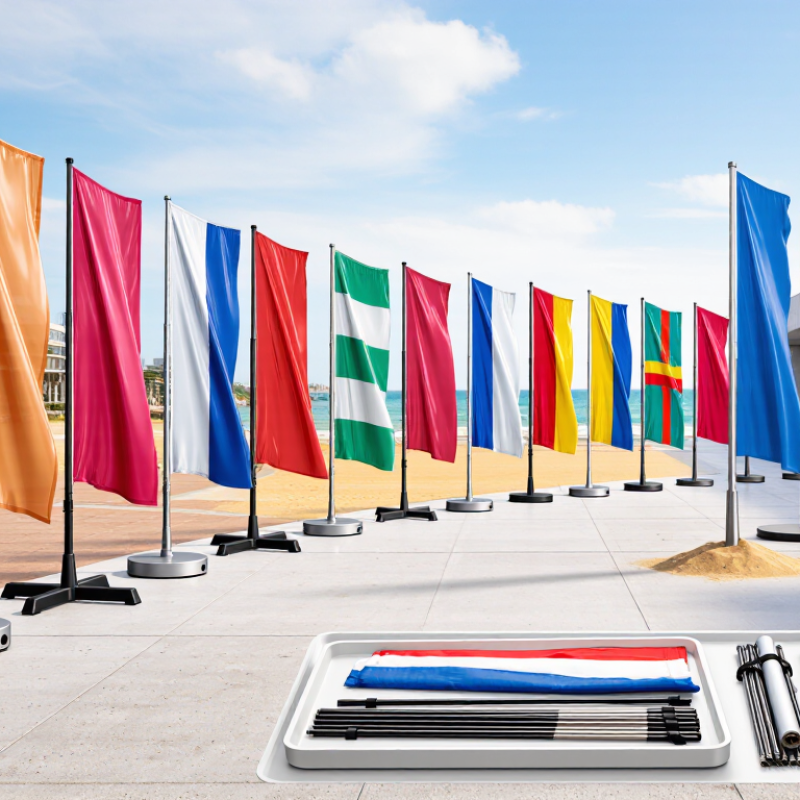
Feather flags are lightweight outdoor signs with a curved, flexible pole and a fabric sleeve. The pole shapes the flag like a feather. Its tension keeps the printed message visible while the fabric moves with air. A ground base supports the pole, and many bases allow the flag to rotate in changing wind.
In practical use, I have found that placement matters as much as printing. A flag near a busy entrance attracts attention quickly. A flag behind a wall may disappear from view. Global buyers should check fabric strength, stitching, pole flexibility, base weight, and packing size. Polyester is commonly used because it dries quickly and accepts vivid graphics. However, no fabric performs perfectly in every climate. Strong wind, rain, and rough ground can shorten its service life. Buyers should follow the supplier’s wind guidance and inspect the pole before each outdoor use.
Tips: Choose a base for the surface and weather conditions. Test the flag from several viewing angles. Keep important text large and brief. Ask for a physical sample when color accuracy matters. I once underestimated base stability at a windy event, and the flag leaned more than expected. That mistake showed me that attractive design cannot replace proper site planning. Check dimensions, artwork files, delivery timing, and care instructions before ordering. A clear specification reduces misunderstandings across languages and markets.
Which Feather Flag Materials Suit Different Climates?
For global buyers, climate should guide the feather flag fabric choice. The World Meteorological Organization reported that 2023 was about 1.45°C above the pre-industrial average. Hotter conditions increase fading, drying, and fabric stress. Outdoor testing experience suggests knitted polyester suits many markets because it balances strength, print clarity, and water resistance. A 110–120 gsm fabric usually performs well for short campaigns and moderate wind. It is not indestructible.
Nylon is lighter and can produce brighter colors, making it useful for calm, dry locations. However, prolonged ultraviolet exposure may weaken it faster. In rainy or coastal climates, polyester is generally safer because it absorbs less moisture and dries quickly. Mesh polyester can help in exposed areas by allowing wind to pass through the flag. That trade-off matters. Colors may appear less solid. Textile Exchange’s Materials Market Report 2024 estimated polyester represented about 57% of global fiber production, supporting its broad availability and consistent manufacturing. For high-sun regions, buyers should request UV-resistant testing, not just a “weatherproof” claim. In colder zones, inspect stitching and pole flexibility after freezing nights. The International Organization for Standardization recommends evaluating textile colorfastness under controlled light exposure, but laboratory results cannot fully predict every installation site. Local wind records still matter. A beautiful flag can fail when its base is too light.
What Are the Best Feather Flags for Global Buyers?
Which Feather Flag Materials Suit Different Climates?
Polyester is a balanced choice for most climates because it offers good color retention, low moisture absorption, and practical durability. Nylon is lightweight and dries quickly, but it generally needs more protection from prolonged sunlight. Acrylic-coated polyester performs well in humid, rainy, and coastal environments because the coating improves resistance to moisture and weather exposure.
Suitability scores use a comparative 1–10 planning scale based on common textile characteristics including UV exposure, moisture, drying speed, and weather resistance. Actual performance also depends on fabric weight, coating quality, stitching, printing method, and installation conditions.
How Should Global Buyers Compare Sizes, Shapes, and Printing?
What Are the Best Feather Flags for Global Buyers?
Global buyers should compare feather flags by location, viewing distance, and expected wind exposure. A compact flag suits shop entrances and crowded walkways. Larger flags create stronger visibility beside roads or spacious exhibition areas. However, bigger is not always better. A tall flag may become difficult to transport, install, or stabilize on uneven ground. Measure the available space before choosing a size.
Shape affects both movement and readable area. Feather-shaped flags usually provide a long vertical display with a curved top edge. Teardrop shapes often hold their fabric more tightly in moderate wind. Straight-edged designs can offer clearer text placement, but they may look less dynamic. Test the design at eye level. Small lettering can disappear quickly. It happens more often than buyers expect.
Printing quality deserves careful comparison. Ask whether the fabric uses dye-sublimation or another durable process. Check color samples under outdoor light, not only on a screen. Single-sided printing may show a softer reverse image. Double-sided construction improves visibility but adds weight and cost. Leave enough space around logos and essential words. A crowded flag becomes hard to understand from a distance. I have learned that a perfect digital proof can still feel weak outdoors. Buyers should request a physical sample when timing allows. Also confirm pole length, base compatibility, packing dimensions, and replacement options before approving a large order.
What Features Ensure Easy Shipping, Setup, and Long-Term Use?
For global buyers, the best feather flags are designed for movement, not just appearance. A lightweight fiberglass pole can reduce freight weight and fit inside a compact carton. A fitted carry bag also protects parts during storage and transport. Check the packed dimensions before ordering. A surprisingly small difference can affect shipping costs.
Setup should feel simple at a busy event site. Look for numbered pole sections, a reinforced sleeve, and a stable base suited to the surface. Ground stakes work well on soil, while weighted bases are safer for concrete. Clear assembly instructions matter, especially for teams working in different languages. Details matter. Test one flag before placing a large order. Product photos rarely show how quickly a joint wears after repeated assembly.
Long-term use depends on fabric, stitching, and maintenance. UV-resistant polyester can help preserve color, but no fabric stays new forever under strong sunlight. Double-stitched edges and reinforced stress points reduce tearing around the sleeve. The flag should dry fully before storage, because trapped moisture creates odor and weakens fibers. Replaceable poles or bases can extend service life and reduce waste. Still, wind conditions vary widely between locations. A design that performs well in one city may need a heavier base elsewhere. Ask for material specifications, care guidance, and tested wind recommendations before buying. Practical evidence is more useful than a bold sales claim.
How Can Buyers Select Reliable Feather Flag Suppliers?
Global buyers need more than a bright image when choosing a feather flag supplier. In production inspections, I look at fabric density, edge stitching, pole joints, and base stability. These details decide whether a flag remains readable after repeated outdoor use. A supplier should provide a physical sample, not only edited photos. Small details matter.
Ask how artwork is checked before printing, how color variation is controlled, and how rejected pieces are handled. Reliable suppliers share material specifications, packing photos, test reports, and clear lead times. They also explain which base suits grass, concrete, or indoor floors. Request a sample using your actual logo and size. A rushed sample can hide weak seams. It is worth asking for production records from similar orders while protecting confidential buyer information.
Communication is another practical test. Send the same technical questions to several suppliers and compare the precision of their replies. Vague promises are not proof of capacity. Check factory videos carefully, but do not treat them as full evidence. A video may show a clean workshop on one day. Independent inspection is safer for large shipments. Still, inspection is not perfect; packaging damage, transport delays, and color expectations can create surprises. Leave written tolerances and approval points in the purchase agreement. The best supplier is not always the cheapest. It is the one that documents limits, admits weak areas, and corrects mistakes quickly.

