How to Choose China Best Lift Chair Repair Services?

Choosing China’s best lift chair repair service requires more than comparing prices online. A reliable provider should understand motors, control systems, wiring, frames, and reclining mechanisms. Experience matters when a chair stops halfway, makes a clicking sound, or leaves its footrest open. Ask how technicians diagnose faults before replacing parts. Careful diagnosis often prevents unnecessary costs.

Look for companies with trained technicians, clear service records, and practical experience with different lift chair brands. Professional teams should explain the repair process in plain English and provide photographs when remote assessment is necessary. They should also use compatible replacement components, test the chair under load, and check emergency lowering functions. Safety comes first. A written warranty adds confidence, especially when repairs involve motors, batteries, or control boxes.

Communication can reveal a company’s reliability. Does it confirm the model number, fault symptoms, travel distance, and expected completion time? Does it provide a realistic quotation instead of promising the lowest price immediately? These details matter when selecting lift chair repair services in China. Customer reviews can help, but they are not perfect evidence. Some may be outdated or overly general. I would compare several sources and request recent case examples before deciding. A strong provider may still make an occasional mistake, yet it should acknowledge problems and correct them promptly. That honesty is often more valuable than polished advertising. Choose a service that combines technical knowledge, transparent pricing, safe procedures, and dependable after-service support.

How to Choose China Best Lift Chair Repair Services?

Understanding Lift Chair Repair Services in China

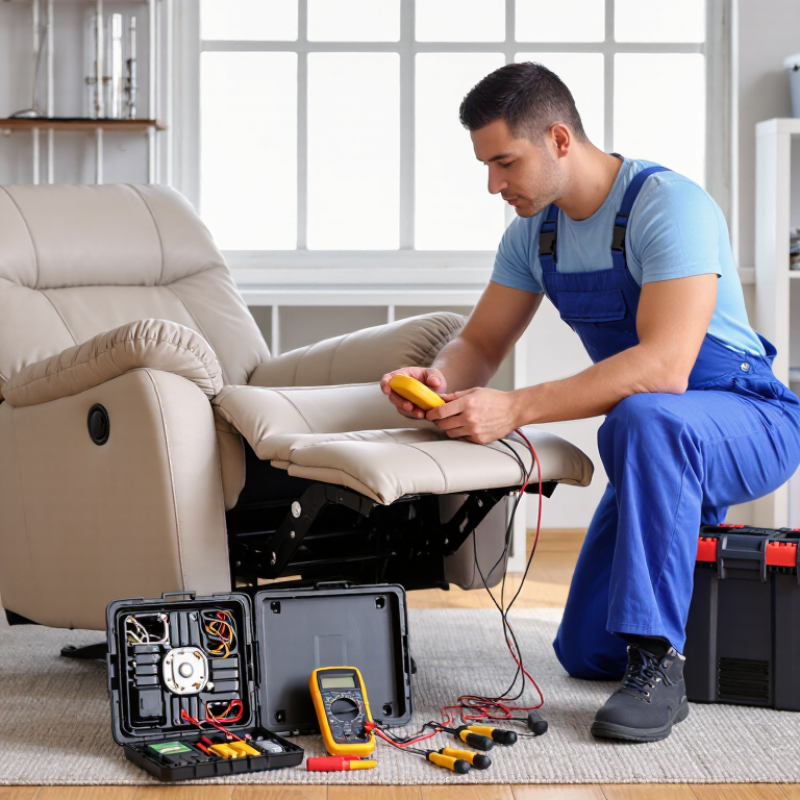
Choosing lift chair repair services in China begins with understanding the repair process, not just comparing prices. Technicians should inspect the motor, handset, wiring, transformer, frame, and reclining mechanism. A careful diagnosis identifies whether the fault needs adjustment, replacement, or professional cleaning. Ask for photos, a written quotation, and an estimated completion date. Clear evidence shows practical experience and improves accountability. Local service teams may understand common electrical standards and regional parts availability.

Reliable providers explain which components are original, compatible, or refurbished. They should test the chair under load after repair, rather than simply making it move once. Request details about labor coverage, replacement-part warranty, return handling, and after-service communication. Qualified technicians can describe safety checks without hiding behind technical language. That matters when a chair is used by an older adult or someone with limited mobility. In practice, low quotes can become expensive after repeated visits. Still, a higher fee does not automatically prove better workmanship. Ask for records.

Tips: Photograph the chair before collection. Record unusual sounds, stopping points, and remote-control symptoms. Confirm pickup protection and payment stages in writing. Check business registration, technician experience, and recent customer feedback. Choose a provider that answers technical questions directly. Do not ignore a burning smell, exposed wire, or sudden movement. Stop using the chair.

How to Choose China Best Lift Chair Repair Services? - Understanding Lift Chair Repair Services in China

Evaluation Dimension What to Check Reliable Service Reference Why It Matters
Service Coverage Confirm whether the provider handles electric lift recliners, power recliners, riser-recliner chairs, massage lift chairs, and manual components. The service scope should match the chair type, control system, motor configuration, and mechanical structure. A repair provider without experience in the relevant chair design may replace the wrong component or overlook a safety issue.
Common Fault Diagnosis Ask whether the technician can test the power supply, hand control, motor, transformer, wiring, limit switches, frame, and recliner mechanism. A written or electronic fault report should identify the suspected cause before parts are replaced. Systematic diagnosis helps prevent unnecessary part replacement and repeated failures.
Technician Capability Check experience with low-voltage DC motors, linear actuators, electrical connectors, control boxes, upholstery removal, and mechanical alignment. Technicians should follow electrical isolation, load testing, pinch-point, and moving-part safety procedures. Lift chairs combine electrical and mechanical systems, so both types of expertise are required.
Initial Response Time Review the time required to acknowledge an inquiry, request photos or videos, and provide preliminary troubleshooting advice. A professional provider normally acknowledges service requests within one business day and confirms the next step clearly. Fast communication is particularly important when the chair is used by an elderly or mobility-limited person.
Diagnostic Process Determine whether the provider uses a checklist covering abnormal noise, incomplete lifting, sudden stopping, overheating, remote failure, and unstable movement. The process should distinguish between a power issue, control issue, actuator issue, frame issue, and upholstery obstruction. Accurate diagnosis improves repair quality and makes the quotation easier to verify.
Replacement Parts Verify compatibility of motors, actuators, hand controls, transformers, control boxes, cables, batteries, gears, brackets, and fasteners. Parts should match the original voltage, connector type, stroke length, load rating, dimensions, and mounting position. Visually similar parts may have different electrical specifications or load capacities.
Parts Traceability Request the part number, technical specification, production information, and installation record for replaced components. The repair record should identify the replaced part and retain the removed part when practical. Traceability supports future maintenance, warranty claims, and repeat-order accuracy.
Warranty Terms Check separate warranty terms for parts, labor, shipping damage, installation quality, and repeat failure of the same component. The warranty should state its duration, exclusions, claim procedure, and responsibility for return shipping. Clear warranty conditions reduce disputes after the repair is completed.
Repair Documentation Ask for before-and-after photographs, fault descriptions, replaced-part details, test results, and final recommendations. A complete service report should record the chair model, reported fault, repair action, tested functions, and date. Documentation is useful for quality control, insurance records, and future troubleshooting.
Functional Testing Confirm that the chair is tested through the complete lift, recline, return, and stop cycles after repair. Testing should include remote-button response, smooth movement, emergency stopping, unusual noise, and cable clearance. A component can appear to work while the chair still has an unsafe alignment or movement problem.
Safety Inspection Check frame stability, loose fasteners, damaged cables, exposed wires, pinch points, motor temperature, and load-bearing connections. The provider should recommend stopping use when there is burning odor, sparking, exposed wiring, structural damage, or uncontrolled movement. Safety defects can create fall, crush, electrical, or fire risks.
Quotation Transparency Review the diagnostic fee, labor charge, parts cost, packaging, transportation, taxes, and any additional service fees. The quotation should separate labor and materials and require approval before additional work is performed. Itemized pricing makes different repair proposals easier to compare.
Remote Troubleshooting Evaluate whether the provider can guide basic checks such as outlet testing, cable inspection, connector reseating, and hand-control verification. Remote instructions should be limited to low-risk checks and should not ask unqualified users to open energized equipment. Some simple faults can be identified without shipping the entire chair.
Packaging and Logistics For shipped parts or returned components, check protective packaging, moisture protection, labeling, tracking, and damage-report procedures. Heavy or fragile components should be packed to prevent impact, connector damage, bending, and moisture exposure. Correct logistics procedures help prevent transport damage from being mistaken for a repair defect.
Spare-Part Availability Ask whether frequently replaced parts are stocked or supplied with a stated procurement lead time. Common service items include hand controls, power supplies, control boxes, actuators, cables, and mounting hardware. Accessible spare parts shorten downtime and reduce the risk of an incomplete repair.
After-Sales Support Assess communication channels, operating hours, escalation procedures, technical follow-up, and support for installation questions. Support should provide a clear contact person and a documented process for reporting recurring faults. Follow-up assistance is important when a problem reappears after installation or transportation.
Total Service Value Compare technical capability, compatible parts, documentation, warranty, response time, logistics, and total cost rather than price alone. The best option should offer verifiable technical information, safe procedures, transparent pricing, and appropriate warranty coverage. Lower initial pricing may lead to higher costs if unsuitable parts or incomplete repairs cause repeat failures.

Note: Service times, warranty periods, fees, and parts availability vary according to the chair model, fault type, repair location, and shipping requirements. Confirm all terms in writing before authorizing the repair.

Assessing Lift Chair Technicians and Technical Expertise

Choosing China’s best lift chair repair service starts with the technician, not the advertised price. The World Health Organization and UNICEF report that over 2.5 billion people need assistive products worldwide. A faulty lift chair can therefore affect daily independence, not merely comfort. Ask whether the technician has repaired the same lifting mechanism, handset, actuator, and battery system before.

Look for practical evidence. The technician should inspect wiring, limit switches, frame joints, emergency lowering functions, and unusual motor noise. They should also test the chair under realistic user weight, not only during an empty demonstration. The U.S. Bureau of Labor Statistics projects 5% growth in installation, maintenance, and repair occupations from 2023 to 2033, with about 645,000 annual openings. That figure covers many trades, so it does not prove lift-chair expertise. It does show why broad repair experience needs careful verification.

Request a written diagnosis, parts specification, labor cost, and safety test record. Check whether replacement components meet relevant electrical-safety requirements in China. A confident technician explains failure causes in plain language. Be cautious when every problem supposedly requires a full motor replacement. That is a warning sign. A certificate helps, but it cannot replace hands-on judgment. I would also ask for service photos or anonymized case records. One inspection is never perfect. Loose connectors may reappear after vibration, and intermittent faults can escape a short visit. Reliable technicians explain these limits and arrange a sensible follow-up check.

Checking Repair Capabilities, Parts, Tools, and Service Coverage

How to Choose China Best Lift Chair Repair Services?

China-based lift chair repair services should be judged by capability, not attractive pricing. The WHO and UNICEF Global Report on Assistive Technology (2022) estimates that over 2.5 billion people need assistive products worldwide. That demand makes technical consistency essential. Ask whether technicians can diagnose motors, control handsets, transformers, wiring, reclining frames, and battery systems. A useful test includes repeated lifting cycles, load checks, and inspection for unusual heat or noise. A quick reset is not a complete repair.

Parts quality matters. Request a written list of compatible motors, cables, switches, fuses, and upholstery components. Confirm whether parts are tested, traceable, and stored under suitable conditions. Generic replacements may fit physically but fail under daily load. That mistake is easy to overlook. Repair teams should carry insulated meters, torque tools, continuity testers, and safe lifting equipment. Photographs before and after service can improve accountability, although photographs alone prove little.

Service coverage deserves equal attention. Check onsite support, pickup procedures, remote diagnosis, response times, warranty terms, and coverage across major Chinese regions. The provider should explain travel charges and parts delays before accepting the job. A service report should record the fault, replaced components, test results, and technician identity. WHO and UNICEF also report that access to assistive technology remains unequal, so dependable regional support has practical value. Still, no checklist is perfect; ask how the company handles a repair that returns within weeks.

Comparing Costs, Warranties, Response Times, and Customer Support

Choosing China’s best lift chair repair service requires more than comparing the lowest quote. Ask for separate prices for diagnosis, labor, transport, parts, and tax. A technician should identify whether the fault comes from the motor, handset, transformer, wiring, or frame. In practice, a cheap repair can become expensive after repeated visits. Salesforce’s State of Service report found that 83% of customers expect issues resolved by one representative. This makes technical competence important.

Warranty terms deserve close attention. Request written coverage for replacement parts and labor, including exclusions for misuse and moisture damage. A useful warranty should state its duration and claim process clearly. Response time also matters for elderly users who rely on powered movement. Zendesk’s Customer Experience Trends report states that 73% of customers may switch after several poor service experiences. That figure is not specific to lift chairs, but it shows why delayed replies can damage trust. Good support should provide a ticket number, arrival window, and follow-up call.

Tips: Compare three written quotations. Check parts compatibility. Ask whether technicians carry common motors and controllers. Test the chair repeatedly before payment. Keep photos of the fault and repair invoice. A service promising same-day arrival may still lack qualified staff. That risk is easy to overlook. My own checklist would score response time, warranty clarity, and communication before price. A minor weakness remains: public repair data for China’s lift-chair sector is limited, so customer reviews should support, not replace, technical verification.

Selecting a Reliable China Lift Chair Repair Provider

How to Choose China Best Lift Chair Repair Services?

Selecting a Reliable China Lift Chair Repair Provider

A dependable repair provider should understand motors, lifting mechanisms, remote controls, wiring, and heavy-duty frames. Ask how technicians diagnose faults before replacing parts. A careful provider will request photos, model details, and a clear description of the problem. This shows practical experience, not just sales language.

Check the technician’s training and repair records. Skilled teams can explain why a chair stops lifting, reclines unevenly, or makes clicking sounds. Request a written quotation covering labor, replacement parts, shipping, and testing. Hidden charges create unnecessary stress. A reliable provider should also offer a clear repair warranty and explain its limits. Ask for inspection photographs when remote diagnosis is used.

Communication matters greatly. Response speed is useful, but accurate answers matter more. The provider should confirm voltage requirements, compatible components, and expected repair time. One low quotation may look attractive. It can become expensive if poor parts fail again. I would rather choose a slightly higher quote with documented testing. Still, written promises are not enough. Verify company details, customer feedback, service history, and after-sale support. Some reviews may be outdated or overly positive. That deserves caution. Before approving work, confirm packaging standards for returned components and ask how damaged parts are handled. Small details often reveal professional habits. A trustworthy repair partner may admit uncertainty and recommend further testing. That is more credible than an instant guarantee.

How to Choose China Best Lift Chair Repair Services?

Select a reliable China lift chair repair provider by comparing the factors that most directly affect safety, service quality, cost, and long-term reliability.

How to use this chart: Give greater priority to technician qualifications, genuine replacement-part availability, safety compliance, and warranty coverage. Response time and transparent pricing should also be verified before confirming a repair order.

©2024 Home Health Solutions by The Medicine Shoppe
cross linkedin facebook pinterest youtube rss twitter instagram facebook-blank rss-blank linkedin-blank pinterest youtube twitter instagram